
 English
 Arabic
 Chinese (Simplified)
 Dutch
Dutch French
 German
 Italian
 Portuguese
 Russian
 Spanish
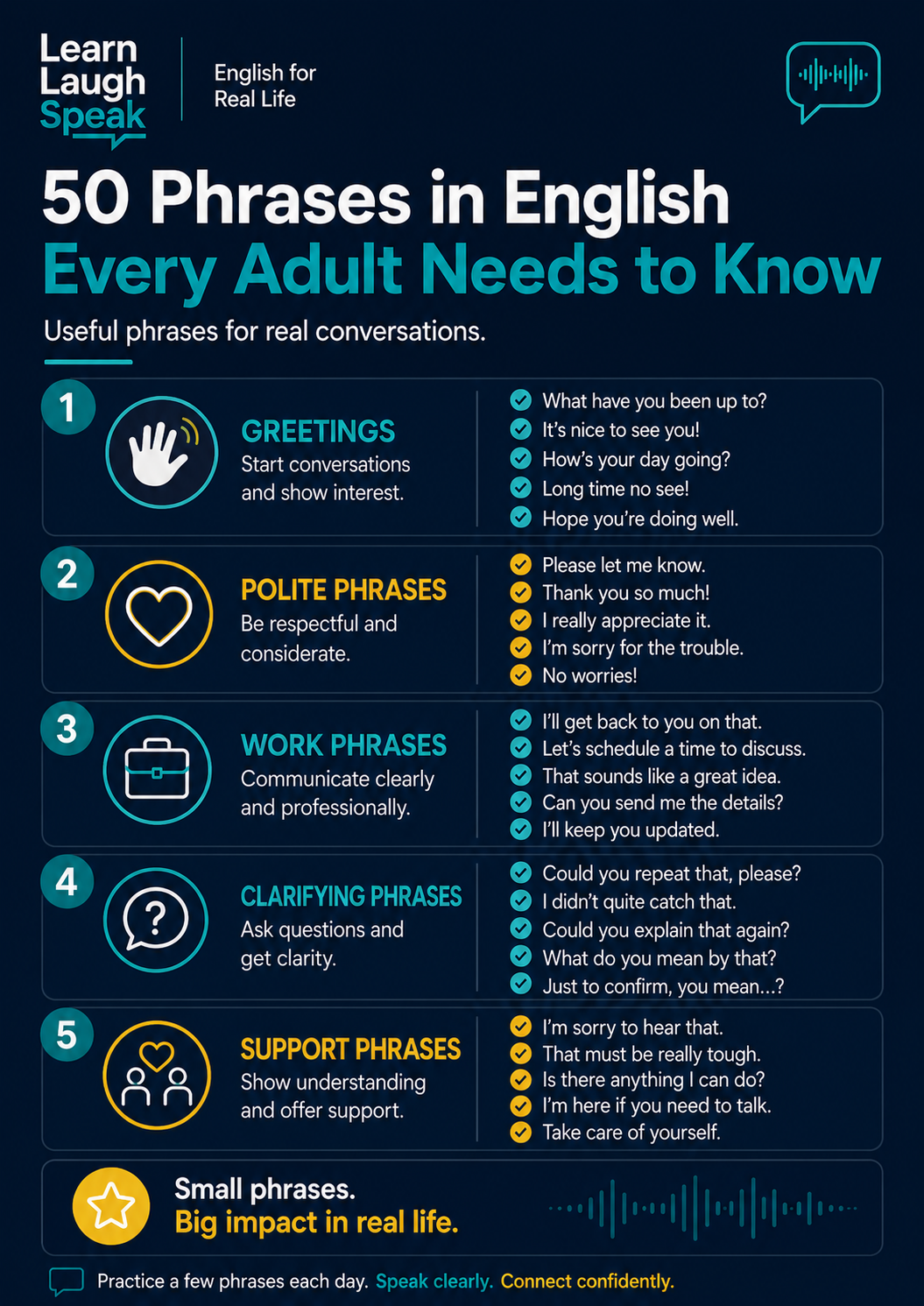
These 50 phrases in English every adult needs to know will help you speak more naturally in everyday conversations, workplace situations, emails, customer service, social plans, and polite communication. They include phrases for greeting people, leaving conversations, offering help, asking for clarification, showing support, and speaking professionally.
Learning useful English phrases is one of the fastest ways to sound more natural. You do not need to memorise complicated grammar every time you speak. Sometimes, knowing the right phrase for the right situation helps you communicate more clearly and confidently.
This guide breaks down 50 phrases in English every adult needs to know by situation, with meanings and examples so you can use them in real life.

Why 50 Phrases in English Every Adult Needs to Know Are Useful
Adult English learners often need English for real situations, not only classroom exercises. You may need to speak with colleagues, customers, managers, friends, teachers, hotel staff, or people you meet in daily life.
These phrases help you:
- start conversations naturally
- sound polite and confident
- ask for help or clarification
- leave conversations respectfully
- respond to invitations
- offer support
- handle workplace conversations
- avoid sounding too direct
- build better relationships in English
The goal is not to sound perfect. The goal is to have practical phrases ready when you need them.
50 Phrases in English for Greetings and Everyday Conversations
These phrases help you start conversations, reconnect with people, and sound natural in daily English.
| # | Phrase | Meaning | Example |
|---|---|---|---|
| 1 | What have you been up to? | What have you been doing lately? | “Long time no see! What have you been up to?” |
| 2 | How’s everything going? | How are things in your life or work? | “Hi Ana, how’s everything going?” |
| 3 | How have you been? | How are you since the last time we spoke? | “It’s been a while. How have you been?” |
| 4 | Good to see you. | A friendly greeting when you meet someone | “Good to see you again. How was your weekend?” |
| 5 | Speak of the devil! | We were just talking about you, and now you are here | “We were just mentioning you. Speak of the devil!” |
| 6 | It’s been a while. | We have not spoken or met for some time | “It’s been a while. How are you?” |
| 7 | I’ve heard a lot about you. | People have told me about you before meeting | “Nice to meet you. I’ve heard a lot about you.” |
These phrases are useful in social situations, workplace introductions, networking, and casual conversations.
50 Phrases in English for Leaving or Ending a Conversation
Knowing how to leave a conversation politely is important. These phrases help you end a conversation without sounding rude.
| # | Phrase | Meaning | Example |
| 8 | Take care. | Look after yourself | “I’ll see you next week. Take care.” |
| 9 | I’ll be off then. | I am going now | “That’s everything for today. I’ll be off then.” |
| 10 | I’ll love you and leave you. | Informal British phrase meaning I’m leaving now | “It’s getting late, so I’ll love you and leave you.” |
| 11 | Catch you later. | See you later | “I’m heading out. Catch you later.” |
| 12 | I’ve got to dash. | I have to leave quickly | “Sorry, I’ve got to dash. I have another meeting.” |
| 13 | I’m off out for the evening. | I am going out tonight | “I’m off out for the evening, so I’ll reply tomorrow.” |
| 14 | I’ll let you get back to it. | I will stop interrupting you now | “Thanks for your help. I’ll let you get back to it.” |
For professional English, “I’ll let you get back to it” is very useful because it sounds polite and respectful of the other person’s time.
50 Phrases in English for Politeness and Helping Others
These phrases help you sound kind, helpful, and polite in English. They are useful at work, in customer service, and in daily life.
| # | Phrase | Meaning | Example |
| 15 | Be my guest. | Yes, you can do that | “Can I use this chair?” “Be my guest.” |
| 16 | Help yourself. | Please take one or take what you need | “There’s coffee on the table. Help yourself.” |
| 17 | Make yourself at home. | Feel comfortable here | “Come in and make yourself at home.” |
| 18 | Would you like a hand with that? | Can I help you? | “That box looks heavy. Would you like a hand with that?” |
| 19 | Are you alright with that? | Do you need help? | “That suitcase looks heavy. Are you alright with that?” |
| 20 | Please let me know if I can help. | Offer of support | “Please let me know if I can help with the report.” |
| 21 | No worries. | It is okay / no problem | “Sorry I’m late.” “No worries.” |
| 22 | Never mind. | It does not matter | “I forgot the file.” “Never mind, we can use this version.” |
Note: “No worries” is common in casual and friendly English. In very formal emails, you may prefer “That’s completely fine” or “No problem at all.”
50 Phrases in English for Saying Thank You and Showing Appreciation
These phrases help you sound more natural when someone helps you or does something kind.
| # | Phrase | Meaning | Example |
| 23 | Thank you so much. | Stronger than thank you | “Thank you so much for your help today.” |
| 24 | I really appreciate it. | I value your help | “I really appreciate you taking the time to explain this.” |
| 25 | Cheers. | Informal thank you, common in British/Australian English | “Here’s your coffee.” “Cheers.” |
| 26 | Ta. | Very informal British thank you | “I’ll send that to you.” “Ta.” |
| 27 | Nice one. | Informal way to say thanks or well done | “You fixed it? Nice one.” |
| 28 | That was very kind of you. | Polite appreciation | “Thank you for waiting. That was very kind of you.” |
For adult learners, it is important to know which phrases are informal. “Ta” and “nice one” are not the best choices in formal business emails, but they are useful to understand in casual English.
50 Phrases in English for Agreeing, Choosing, and Responding
These phrases help you respond naturally when someone asks for your opinion, gives you options, or makes a suggestion.
| # | Phrase | Meaning | Example |
| 29 | I don’t mind. | Either option is fine | “Do you want coffee or tea?” “I don’t mind.” |
| 30 | That works for me. | I agree with that plan | “Can we meet at 3?” “That works for me.” |
| 31 | Sounds good. | I agree / that is a good idea | “Let’s start tomorrow.” “Sounds good.” |
| 32 | I’m happy with that. | I accept that option | “We can use this version.” “I’m happy with that.” |
| 33 | Let’s go with that. | Let’s choose that option | “This design is clearer. Let’s go with that.” |
| 34 | That makes sense. | I understand and agree | “We should send the email first.” “That makes sense.” |
These are useful in meetings, planning, teamwork, and daily conversations.
50 Phrases in English for Clarifying and Checking Understanding
If you do not understand something, it is better to ask politely than to stay silent. These phrases help you avoid confusion.
| # | Phrase | Meaning | Example |
| 35 | Could you repeat that, please? | Ask someone to say it again | “Sorry, could you repeat that, please?” |
| 36 | Could you explain that another way? | Ask for a clearer explanation | “I’m not sure I understand. Could you explain that another way?” |
| 37 | Just to confirm… | Check information | “Just to confirm, the meeting is at 10 a.m.?” |
| 38 | What do you mean by that? | Ask for meaning | “What do you mean by ‘final version’?” |
| 39 | I’m not sure I follow. | I do not fully understand | “I’m not sure I follow. Could you give an example?” |
| 40 | Can I check one thing? | Polite way to ask a question | “Can I check one thing before we continue?” |
These phrases are very important for workplace English because they help you sound professional while asking for clarity.
50 Phrases in English for Workplace and Professional Situations
These phrases help adults communicate better at work, especially in meetings, emails, customer service, and team conversations.
| # | Phrase | Meaning | Example |
| 41 | I’ll get back to you on that. | I will check and reply later | “I’m not sure about the price. I’ll get back to you on that.” |
| 42 | I’ll look into it. | I will investigate or check | “Thanks for telling me. I’ll look into it.” |
| 43 | Could you send that over? | Please send it to me | “Could you send that over when you have a chance?” |
| 44 | I’ll take care of it. | I will handle it | “Don’t worry, I’ll take care of it.” |
| 45 | Thanks for the update. | Thank you for the new information | “Thanks for the update. I’ll review it today.” |
| 46 | Let’s touch base later. | Let’s speak again later | “I’m busy now, but let’s touch base later.” |
| 47 | I’ll keep you posted. | I will update you | “I’ll keep you posted if anything changes.” |
| 48 | Can we revisit this later? | Can we discuss this again later? | “We need more information. Can we revisit this later?” |
These are useful phrases for professional English because they are polite, clear, and common in real workplaces.
50 Phrases in English for Support, Problems, and Difficult Moments
These phrases help you respond when someone is stressed, disappointed, confused, or dealing with a problem.
| # | Phrase | Meaning | Example |
| 49 | Keep your chin up. | Stay positive / do not give up | “I know today was difficult. Keep your chin up.” |
| 50 | I’m sorry to hear that. | Show sympathy | “You’re not feeling well? I’m sorry to hear that.” |
| 51 | That must be difficult. | Show understanding | “That must be difficult. Let me know if I can help.” |
| 52 | I understand your concern. | Acknowledge a problem professionally | “I understand your concern, and I’ll check this for you.” |
| 53 | Let’s find a solution. | Focus on solving the problem | “I know this is frustrating. Let’s find a solution.” |
| 54 | Don’t be too hard on yourself. | Encourage someone | “Everyone makes mistakes. Don’t be too hard on yourself.” |
| 55 | We’ll figure it out. | We will solve the problem | “This is a challenge, but we’ll figure it out.” |
| 56 | I’m here if you need anything. | Offer support | “I know this is a hard time. I’m here if you need anything.” |
Because the old article already included several useful phrases, this refreshed version keeps those strong conversational expressions and expands them into a more practical adult-learning guide. To keep the title clear, the main list still gives 50 core phrases, while this section includes a few extra support phrases learners can also use.
The 50 Core Phrases in English Every Adult Needs to Know
Here is the clean list of the 50 phrases in English every adult needs to know from this article:
- What have you been up to?
- How’s everything going?
- How have you been?
- Good to see you.
- Speak of the devil!
- It’s been a while.
- I’ve heard a lot about you.
- Take care.
- I’ll be off then.
- I’ll love you and leave you.
- Catch you later.
- I’ve got to dash.
- I’m off out for the evening.
- I’ll let you get back to it.
- Be my guest.
- Help yourself.
- Make yourself at home.
- Would you like a hand with that?
- Are you alright with that?
- Please let me know if I can help.
- No worries.
- Never mind.
- Thank you so much.
- I really appreciate it.
- Cheers.
- Ta.
- Nice one.
- That was very kind of you.
- I don’t mind.
- That works for me.
- Sounds good.
- I’m happy with that.
- Let’s go with that.
- That makes sense.
- Could you repeat that, please?
- Could you explain that another way?
- Just to confirm…
- What do you mean by that?
- I’m not sure I follow.
- Can I check one thing?
- I’ll get back to you on that.
- I’ll look into it.
- Could you send that over?
- I’ll take care of it.
- Thanks for the update.
- Let’s touch base later.
- I’ll keep you posted.
- Can we revisit this later?
- Keep your chin up.
- I’m sorry to hear that.
What Not to Say and What to Say Instead
Some short English phrases can sound too direct, especially at work. Here are better options.
| What not to say | What to say instead |
| “What?” | “Could you repeat that, please?” |
| “Give me that.” | “Could you send that over?” |
| “I don’t know.” | “I’ll look into it.” |
| “No.” | “I’m sorry, that doesn’t work for me.” |
| “Wait.” | “Please give me a moment.” |
| “It’s not my problem.” | “Let’s find the right person to help.” |
| “You’re wrong.” | “I see it differently.” |
| “I don’t understand.” | “Could you explain that another way?” |
Small changes like these help you sound more polite, confident, and professional.
How to Practise These 50 Phrases in English
The best way to learn these phrases is not to memorise all of them at once. Choose a few phrases and practise them in real situations.
Try this method:
- Choose five phrases from one section.
- Say them out loud.
- Write one example sentence for each phrase.
- Use one phrase in a real conversation or message.
- Repeat the phrase until it feels natural.
Example practice:
Phrase: “Just to confirm…”
Workplace sentence: “Just to confirm, are we meeting at 3 p.m.?”
Email sentence: “Just to confirm, I’ll send the final version tomorrow.”
This helps you understand how the phrase works in different situations.
Learn 50 Phrases in English with Learn Laugh Speak
Learn Laugh Speak helps adult English learners improve practical English for work, daily life, customer service, hospitality, meetings, emails, and real conversations.
Learning 50 phrases in English every adult needs to know is a strong starting point, but real progress comes from using phrases in the right situation. You need to understand tone, context, pronunciation, listening, and how people actually speak.
With Learn Laugh Speak, students practise English step by step at the right level, from beginner to advanced. The goal is simple: help adults communicate clearly and confidently in real life.

FAQs About 50 Phrases in English Every Adult Needs to Know
What are the most useful phrases in English for adults?
Useful English phrases for adults include “What have you been up to?”, “Could you repeat that, please?”, “I’ll look into it,”, “That works for me,”, and “I really appreciate it.” These phrases help in daily life and work.
Why should I learn phrases instead of only single words?
Phrases help you speak faster and more naturally because you learn words together in context. This makes it easier to use English in real conversations.
Are these 50 phrases useful for work?
Yes. Many of these phrases are useful for workplace English, including “Just to confirm,” “I’ll get back to you,” “Thanks for the update,” and “Could you send that over?”
Are phrases like “ta” and “cheers” formal?
No. “Ta” and “cheers” are informal and common in British or Australian English. They are useful to understand, but in formal emails, use “thank you” or “I appreciate it.”
How can I remember these phrases?
Practise five phrases at a time. Use them in sentences, repeat them out loud, and try using one phrase in a real conversation or message each day.
What is the best way to sound natural in English?
Learn common phrases, listen to how people use them, practise pronunciation, and use them in real situations. Natural English comes from repeated practice, not only memorisation.
Final Thoughts on 50 Phrases in English Every Adult Needs to Know
These 50 phrases in English every adult needs to know can help you sound more natural, polite, and confident in real conversations. They are useful for greetings, leaving conversations, offering help, saying thank you, agreeing, clarifying, working with others, and showing support.
Start with the phrases you need most often. Practise them out loud, use them in messages, and listen for them in real conversations.
Over time, these phrases will become part of your natural English and help you communicate more clearly in daily life and at work.